 Maestro
Churrasco Recipe
Last Updated: 2026-08-17
Notes on churrasco, i.e. Brazilian barbeque. What it is and how to do it.
Cultural Context
churrasco (choo has ko), aka Brazilian barbeque, is a significant part of social life for the Brazilian side of my family. I would hazard to claim churrasco is a big part of most Brazilian families. Family gatherings, get-togethers, and celebrations are always supported with churrasco.
Churrasco has a slower rhythm than American backyard barbecues. American barbecues generally follow a simple pattern. There’s the rising action of waiting for stranglers to arrive and the hot dogs and hamburgers to cook, the climax of preparing one’s plate with bun and sides, and the falling action of settling in somewhere to eat. Brazilian barbeque does not have such distinct phases.
In the Brazilian style, meat is grilled continuously, cut into bite size pieces, and passed around the group or served on a communal plate. In my experience, the man of the house is always the one at the grill while their spouse cuts the meat and makes sure everyone gets a piece. The group generally floats around the grill and falls into easy conversation punctuated by a passing of the serving plate. No one has an individual plate; churrasco is finger food and it’s customary to only grab one or two pieces from the serving plate at a time. Drinks and bread are kept within arms reach. This routine continues until the group is satisfied.
I prefer the Brazilian rhythm for a few reasons. First, conversation continues easier with food delivered slowly rather than all at once; no long silences where everyone has their mouth full. Second, There are more openings to slip into and out of the group while still getting plenty of food. Third, the vibe lasts longer and feels more casual.
What to Grill
Brazilian barbeque is less hamburgers and hotdogs and more chicken wings and steak strips. Below is a list of common meat cuts and sides seen in churrasco.
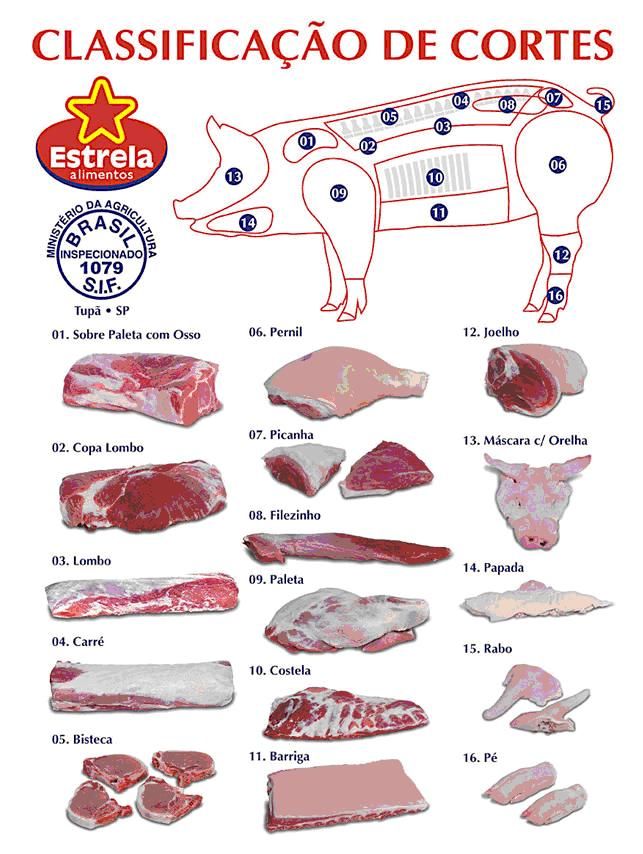
The English translations are approximate. The Brazilians seem to divide up their animals a little differently. I’ve included Brazilian meat cut diagrams for reference I found on Google Images.
Plan on 200-500g of meat per guest.
Beef
- hump steak (cupim)
- tri-tip (maminha)
- striploin (contra filé)
- rump/round steak (picanha)
- flank steak (fraldao)
Season only with course salt.

Just for fun, here’s a cutting board my cousin has that shows all the beef cuts and what they can be used for.

Pork
- rump cap (picanha)
- belly (barriga)
- leg of pork (pernil)
Season with course salt.
Note: Belly meat is mostly fat. Unless you know that’s what you want, I recommend sticking to the other cuts.
Chicken
- heart (coração)
- wing/wingnette (asa)
- wing/drumette (drumete)
Season with course salt, lemon pepper, smoked paprika, chimmichurri and oil. For one kilo of chicken, use a half teaspoon of each seasoning, a full teaspoon of salt, and a tablespoon of oil. Mix the seasonings and oil together, put the mixture in a bag with the chicken and shake or massage the bag to blend everything together. Vegetable or sunflower oil is what’s commonly used in Brazil partly as a cost saving measure and partly because olive oil has a strong flavor. Feel free to adjust the seasonings to your preference.
Fun fact: this is how I learned there are separate words for the different parts of a chicken wing.
Note: I know chicken hearts are not common in American cuisine, but they are easily my favorite barbecue item! Season them the same as the wings and grill them on skewers.

Sides
- Bread rolls (pão francês)
- garlic bread (pão de alho)
- sausage (linguiça)
- Coca-Cola products
Honorable mentions:
- rice (arroz)
- pinto beans (feijão)
- cassava (mandioca)
- grilled mozzarella on a stick
When I am eating churrasco, I am there for meat first and bread second. There is no space for rice, beans, and tubers. However, tradition insists they be included. As for the mozzarella, it’s nice but not nearly as common. Despite being lactose intolerant, I will usually indulge in dairy against my better judgement, but I draw the line at Hell-on-a-stick.
A few notes on translation:
When I say rolls, I am not referring to the common American dinner roll which has a soft, fluffy crust. This stuff has a crunchy crust and a fluffy interior, as pictured below. When Brazilians say bread, this is what they are referring to by default, but it can be specified as French bread. It’s about the size of a fist, is the staple breakfast food, and the most common form of bread in Brazil. The sliced and bagged bread most Americans think of when buying bread is referred to as pão de forma, or formed bread, in Brazil.

Garlic bread is also a little different in Brazil. It has a soft crust and is much smaller than the garlic bread you find in the foil bags in America. Remember, churrasco is a finger food and needs to be bite sized. Store bought garlic bread is kept refrigerated, pre-sliced, and stuffed with enough garlic butter as to drip off when heated. It is grilled alongside the meat rather than baked in an oven.

Sausage has multiple translations, so let me clarify. In the US, you can usually find pre-cooked hot dogs or sausages that technically just need to be heated to serve safely. I am not talking about that kind of sausage. I am talking about the raw sausage you usually find behind the counter in the deli section. Make sure to cook it through while grilling. You can eat it with your fingers or sandwich it inside some bread.
How to grill
Churrasco is not a science. You’re putting meat over heat until it’s cooked; pretty simple and lots of room for personal preference. With that said, here are some of the tips I received in no particular order.
Filet the beef and pork into pieces no thicker than a finger and sprinkle some course salt on both sides. Cup the side of the chosen chunk of meat with your off hand and cut vertical slices with your dominant hand. Your thumb can be a good gauge for thickness, but err on the side of too thin. Pull the full length of the knife through the meat to cut. Lift the knife between cuts; don’t push.

Charcoal is not a requirement. I have only seen small charcoal grills used in Brazil, but that is a cost saving measure rather than a deliberate choice. The cheapest gas grill we found online (I haven’t seen any in store anywhere) was 4x the cost of a comparable model in the US. My FIL would prefer the convenience of gas if it was available. I’m vaguely aware there’s debate amongst Americans on charcoal vs. gas, but with high fire risk in Utah, I am also opting for the convenience of gas.
Fun fact, a grill is called a “churrasqueira” in Portuguese. They commonly take the form of a heavy gauge metal bowl on four legs. The grilling surface is a sheet of metal with 1-in holes throughout. The metal sheet has wooden handles and rests on top of four vertical supports. The sheet is kept as a separate piece for easy cleaning, usually done with a water hose and a literal brick. The brick is surprisingly effective and seems to work as a sort of ablative scrubber.

Knock excess salt off the meat before taking it off the grill to serve. This can be accomplished by beating the top of the meat with your preferred grilling tool.
Flip the meat when blood starts to collect on top. Thicker meat takes longer to pool blood, so if the piece is thick enough you’ll need to flip it before blood starts to collect. I’ve heard Americans claim you should only flip the meat once. My Brazilian family has no such requirement, but be patient. Flipping it repeatedly won’t cook the meat any faster.
Consider letting the meat rest 3 minutes before cutting and serving. This is also not a hard requirement, but has been suggested by a friend of a friend who is supposed really good at churrasco.
Chicken hearts are best grilled on a skewer and are done when they turn a light brown-grey color. If you over cook them, they will get tough but tough is better than under cooked.
Let’s it for now. Happy grilling!
Akelas